

Many documentaries place the past behind the present. Aanikoobijigan [ancestor/great-grandparent/great-grandchild], directed by brothers Adam and Zack Khalil, asks viewers to imagine a less linear relationship between generations. Its subject—the return of Indigenous ancestral remains from institutional collections—makes that formal choice an ethical one.
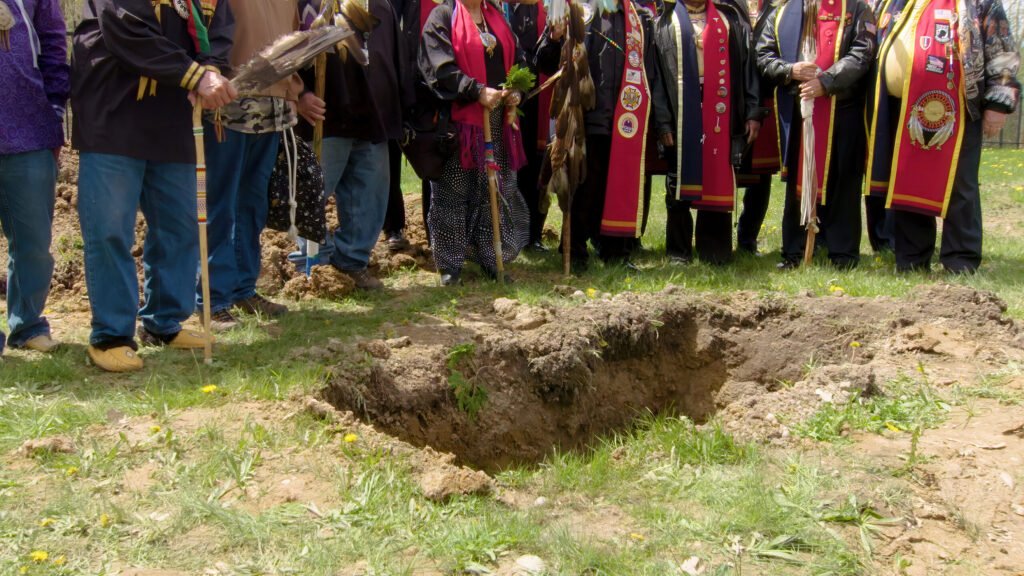
A film about who has the right to hold history
The documentary follows repatriation specialists working to return ancestral remains to Native communities after decades of removal and collection. The Sundance festival report discusses its interviews with museum workers, historians and community participants. It also documents how the filmmakers understand repatriation not as a distant historical dispute, but as work with living consequences.
A conventional documentary might frame the material as a search for facts followed by a resolution. Here, the deeper question concerns whose systems of knowledge determine what those facts mean and who has authority over what happens next.
What the title asks us to consider
Sundance’s account explains the Anishinaabe idea of time invoked by the title: a person can be connected to ancestors and descendants simultaneously, rather than occupying a single point on a straight line. An archive may treat remains as evidence of a historical era; a community may understand them within a continuing relationship and responsibility.
Film form can express that difference. Animation, artistic intervention, interview and archival material need not be arranged as a chronological ladder. They can echo, repeat and transform one another to suggest relationships that exceed a conventional timeline.
The festival response
The film screened in Sundance’s NEXT section and received its Audience Award in 2026. Later, it was among the documentaries presented at the True/False Film Fest in Missouri. The official True/False listing describes its mix of interviews, artistic sequences and meditations on the repatriation process.
Those sources verify its festival trajectory. They do not make a claim of unanimous reception or of this publication having viewed the finished film. Both festivals supply useful context for the kinds of documentary questions the filmmakers are raising.
When structure becomes part of the subject
For screenwriters and documentarians, the main lesson is not to use nonlinear editing because it looks sophisticated. A structure should embody what the film is asking. If a story is about memory, its timeline might reflect recollection. If it is about contested historical accounts, repeating an event from different perspectives can be more honest than presenting one authoritative narration.
But formal experimentation needs orientation. Viewers still require recurring motifs, identifiable people and clear stakes. The form can complicate how events are experienced without hiding why they matter.
Responsibility when portraying vulnerable communities
Creative control is not simply technical. Decisions about who speaks, whose testimony is translated, and how painful images are presented have ethical weight. A filmmaking team should consult the people whose histories it represents and distinguish documentary evidence from artistic speculation.
The challenge is to create a powerful cinematic experience without reducing ancestral remains, living communities or grief to a visual motif.
What emerging filmmakers can practise
Start with a subject you know well and ask what temporal structure the subject itself suggests. A family business may be about recurring gestures across generations. A migration story may move between different places experienced simultaneously. A documentary about a neighbourhood may be organised around objects rather than calendar dates.
Choose a family object with a clear ownership history. Interview two generations about what it means. Assemble the story first chronologically, then around recurring sounds, images or phrases. Notice how the second version changes the argument.
Sources and further reading
- Sundance documentary report and filmmakers’ perspectives
- 2026 Sundance official NEXT Audience Award
- Official 2026 True/False Film Fest documentary listing
- Sundance Institute still and photographer credit
Reporting based on named official festival and distributor materials. This original critical essay does not assert personal festival attendance or a screening.