

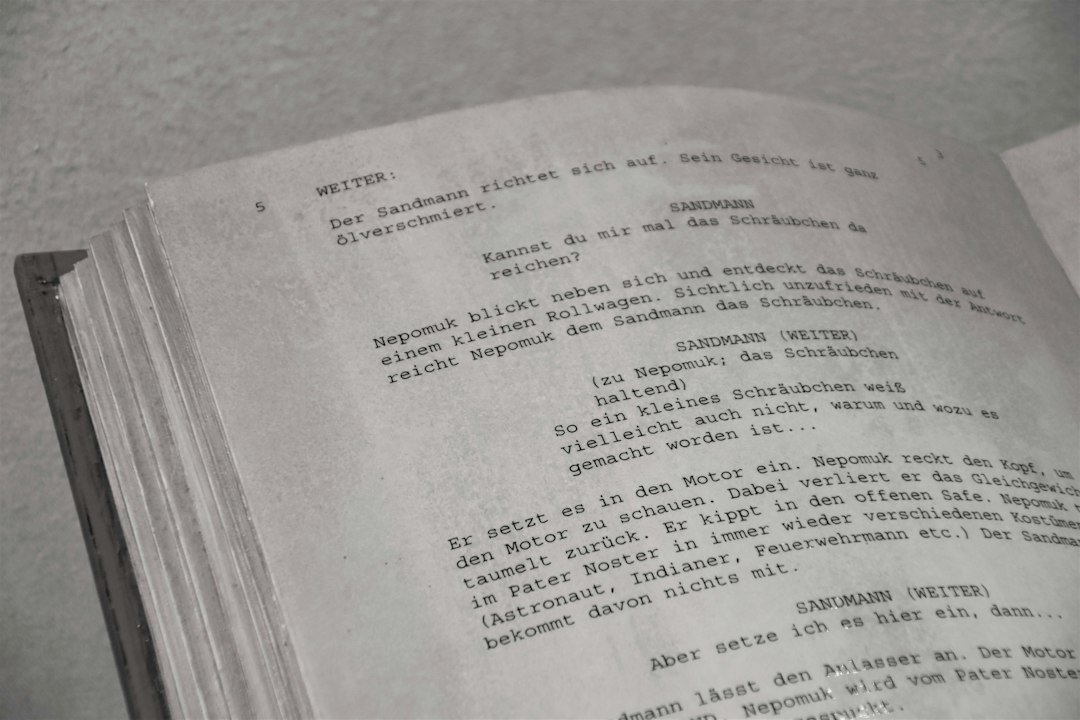
Good screenplay dialogue rarely carries the entire meaning of a scene on its surface. A character can say “I’m fine” while putting a suitcase by the door. Someone can congratulate a rival while quietly checking who else is watching. The words matter, but the scene becomes interesting because the words are only one part of the communication.
That is screenplay dialogue subtext: the audience understands something the character does not state directly. The challenge is that “don’t say exactly what you mean” is incomplete advice. If the hidden intention is invisible, the scene is not subtle; it is simply unclear.
The Academy’s Nicholl judging criteria explicitly ask whether writers use dialogue and description to create tension, drama, comedy and conflict, and whether characters have distinct voices. That is a useful reminder: subtext is not decoration. It should help the scene do dramatic work.
1. Start with what each character wants from the scene
Before polishing dialogue, write one private sentence for each major character: What do they want to happen before this scene ends?
Imagine two sisters meeting after their father’s funeral. One wants the other to sell the family house. The other wants proof that she is not being abandoned again. If both characters simply explain those goals, the scene becomes a negotiation transcript. If they talk only about tea, weather and old furniture without any pressure underneath, it becomes evasive.
The useful version puts the ordinary conversation in contact with the hidden objectives. A question about who kept the spare key can also be a question about who really belongs there. An offer to make tea can be hospitality, delay, control or a final attempt at normality.
Subtext becomes easier to write when the writer knows the text underneath the text.
2. Let behaviour carry part of the sentence
Film has an advantage prose does not: faces, objects, distance, timing and physical choices can contradict dialogue. Scriptnotes has discussed this directly—the audience often works out what a character is thinking through behaviour, choices and performance rather than being told the thought itself.
So when a line feels too explanatory, do not automatically replace it with a more mysterious line. Ask whether an action can carry half the information.
On-the-nose:
MAYA: I’m angry that you didn’t come to the hospital.
With behaviour doing some of the work:
Maya removes a second coffee cup from the table and puts it back in the cupboard.
MAYA: You found parking okay?
The second version is not automatically better in every story. Its advantage is that the audience receives two signals at once: the socially acceptable conversation and the emotional event underneath it.
3. Use contradiction, but give the audience evidence
One of the cleanest forms of subtext is contradiction. A character says one thing while the scene gives us a reason to believe another. John August and Craig Mazin have discussed characters saying the opposite of what they think while the writing makes the subtext legible through context and performance.
The important word is legible. If a character says “I’m happy for you,” the line can mean genuine happiness, jealousy, grief, sarcasm or nothing in particular. The surrounding scene has to narrow the possibilities.
You can create that evidence through a previous beat, an interrupted action, a prop, a change in rhythm, who has power in the room, or what the audience already knows. Subtext asks the viewer to participate, but it should not ask them to guess randomly.
4. Stop using parentheticals to explain every emotion
Writers sometimes create a subtle line and then immediately explain it:
ARUN
(jealous, pretending not to care)
Good for him.
Occasionally a parenthetical is exactly what the read needs. But if every ambiguous line comes with an emotional instruction, the screenplay removes the interpretive space it just created. John August’s guidance on parentheticals makes a similar point: they can communicate pacing and intention, but overuse interrupts dialogue and can signal that the dialogue itself is not carrying enough emotional information.
Try removing the parenthetical and strengthening the circumstances around the line. If the meaning disappears completely, you may need a clearer dramatic setup—not necessarily another instruction in brackets.
This also connects to a broader formatting principle in our screenplay formatting guide for beginners: formatting should make the read clearer, not become a substitute for storytelling.
5. Give the scene a turn
A subtext-heavy scene still needs movement. By the end, something should be harder to hide, newly understood, gained, lost or changed.
A useful revision test is to mark three points: what the audience believes at the beginning, the moment new evidence changes the meaning of the conversation, and what the audience understands at the end. If all three answers are identical, you may have written atmosphere rather than a dramatic scene.
This is particularly useful for writers coming from film school exercises, where “naturalistic dialogue” can become a goal by itself. Naturalism is a texture; drama still needs pressure. If you are deciding how formal training fits into your development, our guide on what aspiring filmmakers actually gain from film school looks at that question more broadly.
A practical subtext rewrite exercise
Take a two-page dialogue scene from your current screenplay and make a temporary copy. First, write each character’s private objective above the scene. Second, highlight every line that directly explains a feeling, relationship or piece of backstory. Third, choose only the lines that genuinely need to be explicit. For the rest, experiment with conflict, behaviour, silence, interruption or contradiction.
Then read the scene without your private objective notes. Can another reader understand the emotional situation without being able to predict every thought? That is the balance worth pursuing.
Subtext is not a contest to see how little your characters can say. It is the craft of making a scene communicate on more than one level at once. The audience hears the conversation, watches the behaviour and senses the gap between them. That gap is where dialogue often becomes cinematic.