

A short film has very little time to establish a world, but that does not mean it must have a small idea. The results of Paris’s 2026 Festival du Film Merveilleux & Imaginaire offer a useful counterargument to the belief that short cinema is merely a rehearsal for features: imagination, technique and emotional specificity can be the form itself.
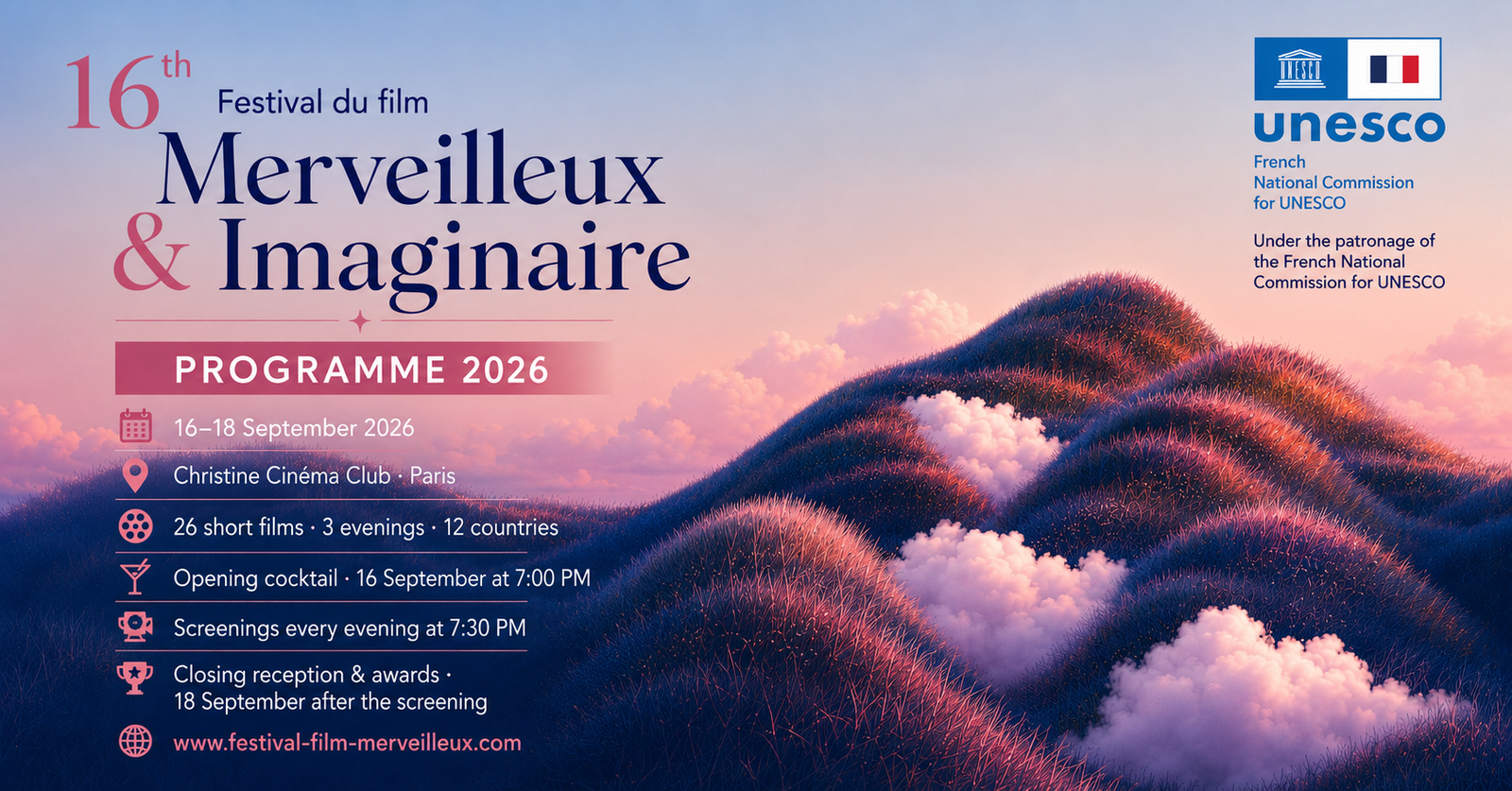
Held at the Christine Cinéma Club from 16–18 September 2026, the festival’s 16th edition presented 26 shorts from 12 countries over three evenings. Those figures and the programme were independently reported by French film publications before the event; the award results were announced by the festival on 22 September. This is a reported reading of the programme and jury decisions, not a claim that Paper Bark attended or screened the films.
What the 2026 jury rewarded
The festival awarded its Best Film prize to Above, directed by Dmitry Borzykin. The official jury announcement describes the film’s distinctive visual world and its attention to learning and perception. The published programme synopsis places it in a future where space exploration is prohibited and a boy discovers an abandoned space museum. Even at the level of premise, the idea demonstrates the value of a concrete rule: forbidding exploration immediately gives curiosity dramatic resistance.
El Din, directed by Julien Regnard and Pascal Giraud, won Best Animated Film. The programme describes a moonlit creature, part dog and part deity, moving through a village by the Nile. The jury cited the film’s artistic identity and animation. These are descriptions from official materials, not a verdict on scenes we have not watched.
The award spread matters because the jury did not simply reward one kind of spectacle. Recognition also went to music, visual effects, screenplay, and a younger audience’s choice—different routes by which a short can make an impression.
Why the screenplay prize is especially interesting
Sulaimani, by Vinnie Anne Bose, received Best Screenplay. The festival describes two interwoven portraits of women from Kerala, made with stop-motion puppetry and animated ink. An independent pre-festival programme account likewise identified its handcrafted technique and two connected stories.
For writers, the significant distinction is between plot size and story design. Two portraits can create a larger emotional field than an overloaded sequence of incidents if their details speak to one another. Parallel stories need not share a timeline or a protagonist to build meaning; they can share a gesture, a question, a repeated object or a tension between generations.
That is also why subtext is not confined to dialogue. An image can withhold, answer or complicate what a character says. Our earlier guide to writing screenplay dialogue with subtext explores the same principle at scene level. Here, the festival’s screenplay award draws attention to structure across an entire short film.
When technique serves the feeling
Strive, directed by Jussi Rautaniemi, won Best Visual Effects. Its official synopsis follows a teenager entering a street race in a future shaped by dependence on machines. The jury’s published rationale praised visual achievement in service of an emotionally powerful story. That phrasing identifies a useful standard: a technique should not merely advertise that it exists.
The Best Music award went to Our Fleeting Soul (Nos âmes fugitives), by Marin Caquez, Eva-Louise Moreau and Nour Kharraz. The festival links its music to a story of Alzheimer’s disease, memory and enduring emotional bonds. In short-form storytelling, sound can compress time: a melody can carry a relationship across scenes without requiring a speech explaining what has been lost.
Neither prize proves that every ambitious effect or score works. It suggests a more productive question for filmmakers planning a short: what can the chosen medium express that an explanatory scene would flatten?
A festival linking fantasy to real-world questions
The 2026 edition also associated selected films with eight of the United Nations Sustainable Development Goals, including education, health, equality and climate action. The SDG Award went to Aidan McAteer’s The Cloud Herder, whose official synopsis follows an elderly shepherdess trying to protect her flock of clouds from a storm she has caused. The Young Audience Award went to Hamed Yousefi’s Gian.
There is a productive tension in this framing. Social themes can give a festival a shared vocabulary, but reducing a film to a single “message” risks erasing its ambiguity. The premise of The Cloud Herder is appealing precisely because responsibility becomes a physical, fantastical problem rather than a lecture. A cloud can be both an imaginative creature and a way to think about consequence.
The festival’s educational ambitions are clear. Still, the best use of such thematic labels is as a doorway to interpretation, not a substitute for watching and discussing the films themselves.
What short-film writers can take from the results
Read these winners as a set of creative prompts, not a recipe for prizes. Above begins with a rule that creates conflict. Sulaimani suggests how two lives can form one structure. Strive poses the challenge of making effects emotionally necessary. The Cloud Herder turns an abstract responsibility into a tangible action. Those observations come from published synopses and jury notes, and should be tested against the films when they become available to view.
Write a one-sentence rule for your story world, a one-sentence emotional contradiction for your protagonist, and one image that can express both without explanation. Then draft a three-page scene around that image. If the scene still makes sense when you remove half the dialogue, the cinematic idea may be doing useful work.
Emerging filmmakers often ask whether they need a larger budget, a more elaborate plot or formal training to be taken seriously. None is a substitute for precision. For a broader discussion of training and practice, see our film-school guide. The 2026 Festival du Film Merveilleux results are a reminder that scale is not measured only in running time.
Sources and reporting note
- Festival du Film Merveilleux & Imaginaire — official 2026 winners and jury notes (22 September 2026)
- Official festival visual assets, permissions and artwork credits
- CineAlliance — independent programme coverage and film synopses (14 September 2026)
- Salles Obscures — independent programme announcement (27 August 2026)
Published 9 October 2026. This is original analysis of publicly announced festival results and official film descriptions, not a firsthand review of the shorts. The festival’s official 2026 artwork is reproduced for editorial coverage only.